Menu

Learning

Enabling Workforces Toolkit

White circle icon that contains a brain, a face, and a muscly arm

Want to be better equipped with the knowledge and skills that enable children and young people to thrive?

Children thrive in environments and relationships where the adults around them understand how the brains and bodies of babies, children and young people develop. Understanding our brains and resilience through the application of neuroscience in practice can support workers, families and children to thrive.
The good news is that, in Australia, we already have many engaging, high quality resources to support those of us who work with children, young people and families. 
Our aim is to ensure that every worker, in every community, can easily access these resources.
That’s why we’ve compiled this simple Toolkit with 100+ learning opportunities.
To make the Toolkit as useful as possible, we’ve sorted the resources according to: 
Length of video/module or training (starting with just a few minutes!)
Intended impact
  • Heart: includes short, emotive, core message dissemination, common language/knowledge 
  • Head: includes understanding the ‘why’, actionable insights, opportunity for reflection into practice
  • Hand: includes deeper understanding of the ‘how’, and ongoing supports
Topics. Under each section you’ll find the following 5 columns (which we refer to as Capability Strands)
Brain Development & Brain Health
Protective & Adverse Childhood Experiences
Trauma & Healing
Resilience
The Whole Person
This Toolkit has been created in partnership through our Enabling Workforces and Organisations for Thriving Kids (EWOT) project. Thanks to our many partners and contributors.
Please note, this Toolkit is being built, tested and improved as we go! We welcome enquiries, feedback, tips and suggestions via our Contact Us page.

3 options to get you started…  

1

Use the section links below to start exploring the Toolkit now. 


2

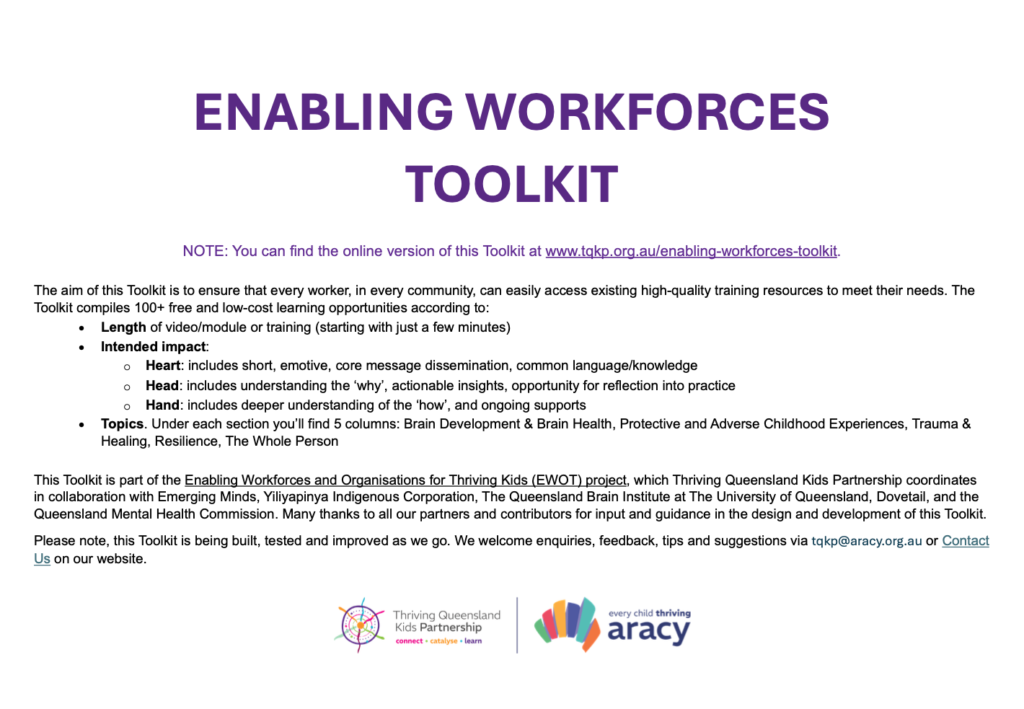
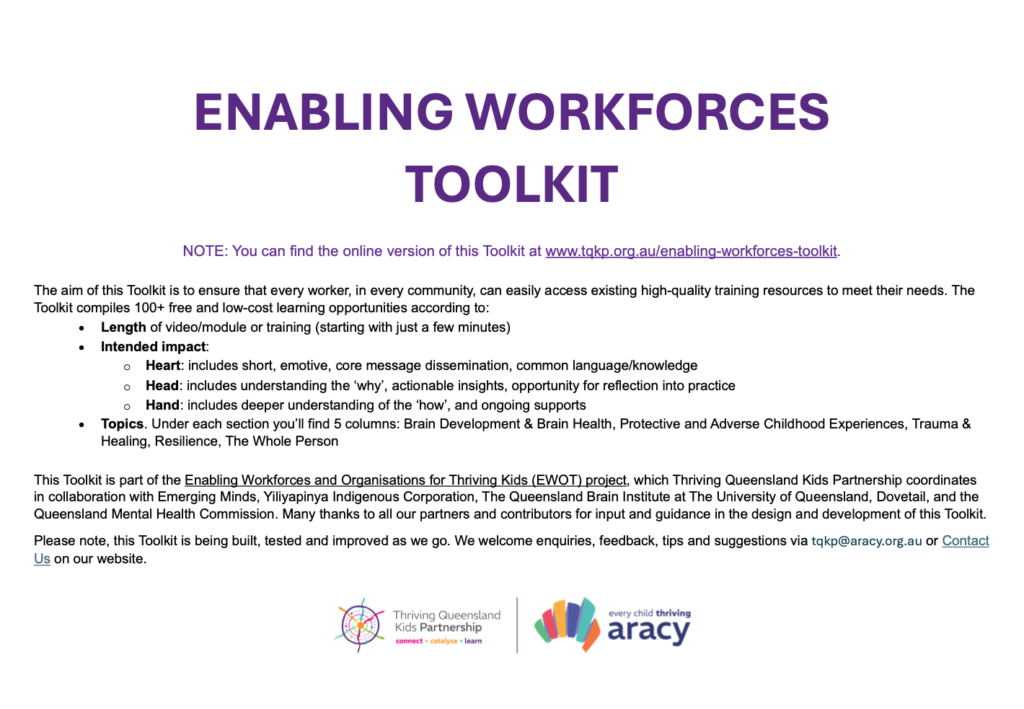
Prefer a document? Download the full Toolkit by clicking on the image.

3

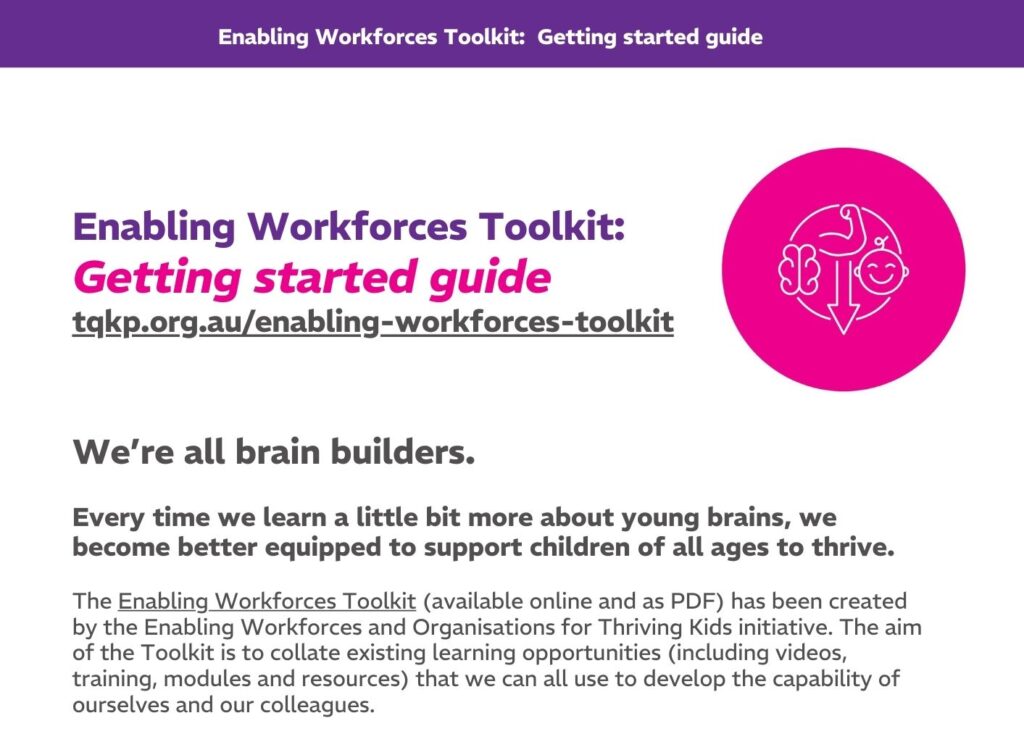
Need inspiration? Download the ‘Getting started guide’ by clicking on the image. 

HEART: includes short, emotive, core message dissemination, common language/knowledge

Less than 20 minutes

HEAD: Understanding the ‘why’, actionable insights, opportunity for reflection into practice

20 minutes - 1 hour

1 – 3 hours

3 - 7 hours

7+ hours

HAND: Deeper understanding of the ‘how’, support for application, ongoing supports

Resources and Communities of Practice

Related links & evidence

DOWNLOAD

Enabling Workforces Toolkit (PDF)

A PDF of the Enabling Workforces Toolkit is also available here for download. 

DOWNLOAD

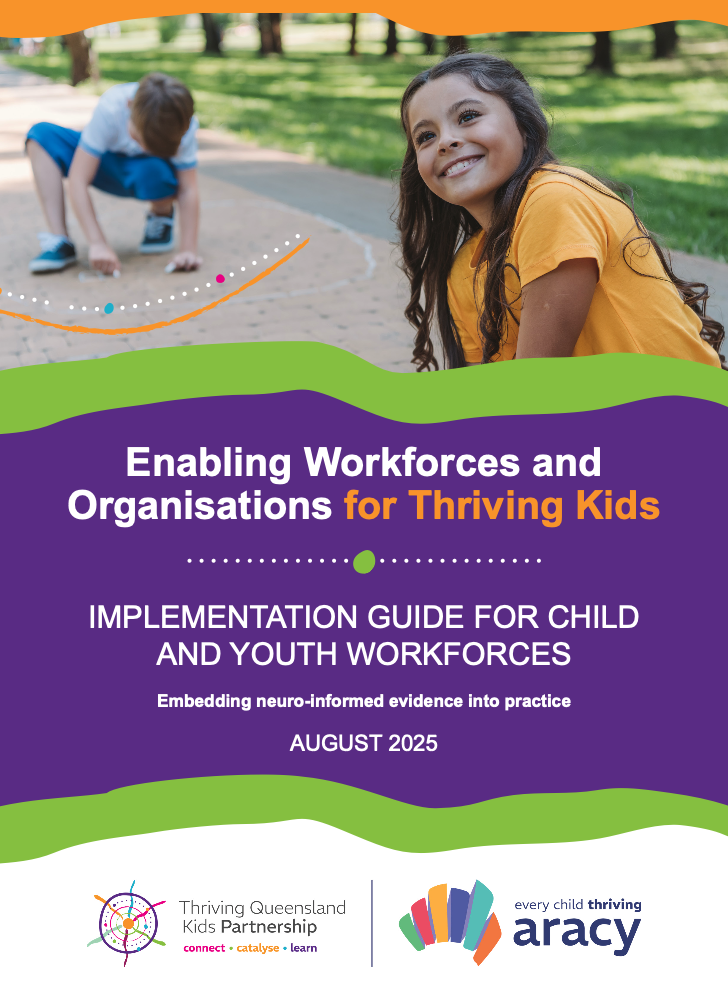
Implementation Guide - for Child and Youth Workforces: Embedding neuro-informed evidence into practice. 

Helpful if you are looking to: Explore the different ways that the neuro-informed capability strands can be used in a range of contexts, including in education, youth justice, child safety and in tertiary institutions. There are case studies from each of the trial and test locations and an implementation science-based guide to developing in your own context.

Image of cover of Implementation guide with a picture of smiling girl in foreground and boy drawing on concrete with chalk
DOWNLOAD

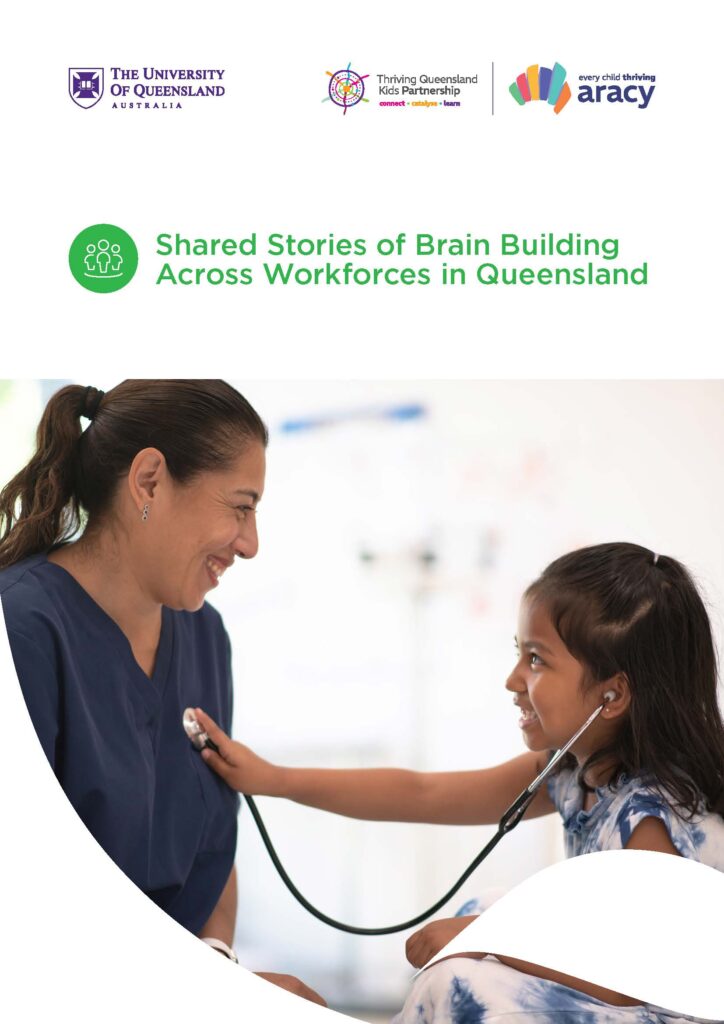
Shared Stories of Brain Building Across Workforces

Shared Stories of Brain Building Across Workforces in Queensland provides real-life examples of how Queensland professionals in a range of sectors are applying the latest neuroscience and brain health knowledge to create the optimal conditions for children’s mental, physical, social, emotional and cognitive development from the early years onwards.

Shared Stories of Brain Building in Queensland
DOWNLOAD

Brain Building Workforces: The Neuro-informed Policy and Practice Framework & Evidence Brief

This work from the Queensland Brain Institute and Thriving Queensland Kids Partnership emerged from a need to establish a clear conceptualisation and identify key knowledge bases that underpin a neuro-informed approach.

QBI Brain Building Workforces Booklet Cover
DOWNLOAD

Brain Builder Workforces Evidence Brief: Neuro-informed Policy and Practice Scoping Review

This scoping review aims to:

  • Establish a working definition of neuro-informed policy and practice that can be applied to different systems, workforces, and contexts.
  • Identify the key knowledge bases and applications of neuro-informed policy and practice, with a particular focus on those relevant to children and young people.
QBI NPP Evidence Brief Final Cover
DOWNLOAD

Brain Builder Workforces: Neuro-informed Policy and Practice Framework

This Framework has been developed as a tool to support systems and services to establish a shared language, shared knowledge, and shared purpose. It was developed through an extensive scoping review of publications describing the application of neuro-informed policy and practice, internationally. 
QBI NPP Framework_Final Cover
SHARE THIS

SHARE THIS