One of the most powerful insights from neuroscience is simple but profound: children’s brains are shaped by what surrounds them.
For early educators, this message is both encouraging and empowering. The environments and relationships we all create every day play an important role in helping children build the foundations for learning, wellbeing and resilience.
Children’s brains grow through experiences and relationships
In the early years, children’s brains are developing rapidly. Every interaction, experience and relationship helps shape the neural pathways that support thinking, learning, emotional regulation and social skills.
This means that brain development is not only about what happens inside the child – it is deeply influenced by the relationships, environments and systems around them.
As many educators know, and aim to prioritise, children thrive when they are surrounded by:
- warm, responsive relationships
- opportunities for play and exploration
- predictable and safe routines
- environments that support emotional wellbeing
Early childhood settings are uniquely positioned to provide these experiences every day.
Creating brain-friendly early learning environments
Early educators are already doing many of the things that support healthy brain development. Small, consistent practices can make a big difference. The phrase ‘We are all brain builders’ is sometimes used to highlight how every interaction has the opportunity to build healthy brain architecture.
How every child can thrive by five, TED Talk with 7-year-old Molly Wright
We are all Brain Builders animation
Relationships with educators
Positive relationships are one of the most powerful drivers of brain development. When children feel safe, seen and supported by trusted adults, their brains are better able to learn and regulate emotions.
Simple interactions – greeting a child warmly, listening attentively, helping them name their feelings – help build strong neural connections and a sense of belonging. In fact, the little things, aren’t little.
We love this video highlighting how family members can help brains through everyday interactions. AFWI Child’s Play
Brain building through play
Play is essential for brain development. Through play, children practise problem solving, creativity, communication and self-regulation.
Having a wide range of play experiences allows children to explore their world, test ideas and build confidence in their abilities.
Also, for adults, play can help alleviate stress, improve mood, and enhance overall mental well-being.
This week is also National Playgroups Week, which is all about celebrating and promoting the benefits of playgroups for children, families and communities. https://www.playgroupaustralia.org.au/national-playgroup-week/
This is about all of us
Children thrive when the adults around them – particularly carers and educators – are well supported. So when we invest time and resources to support the wellbeing of adults – and to understand our own brain health – we are also supporting the brain development of children, now and into the future.
A free helpful webinar by Yiliyapinya founder Sheryl Batchelor gives an overview of brain health and understanding your brain so that you can understand others: https://tqkp.org.au/resources/understanding-your-brain-so-that-you-can-understand-others-sheryl-batchelor/
Understanding resilience: adversity, supports and skills
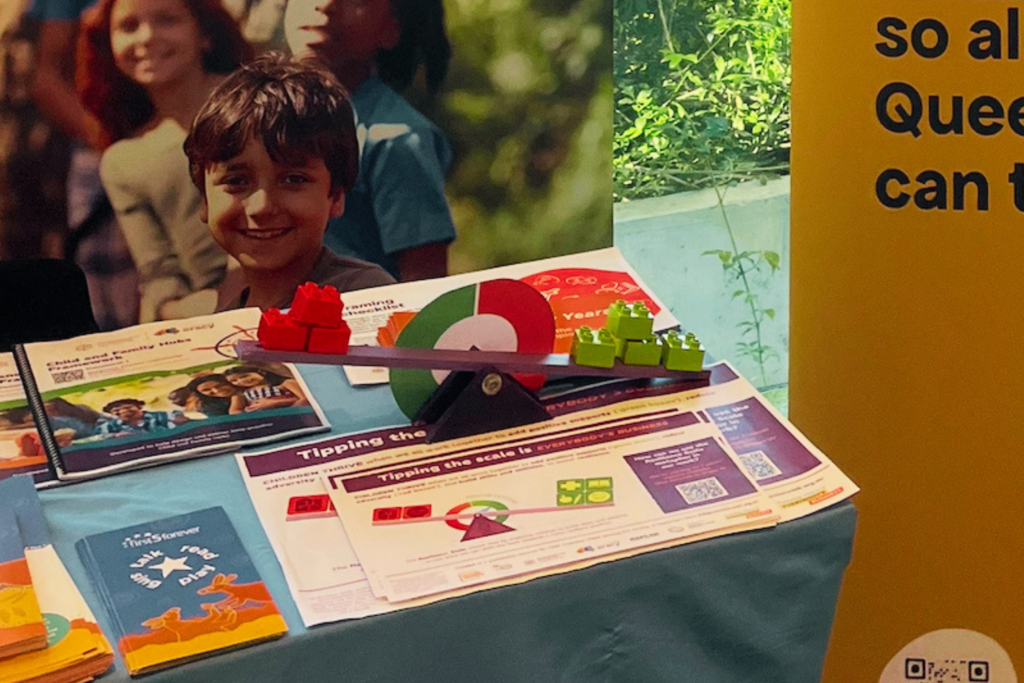
Children’s experiences include both challenges and supports. The Resilience Scale, developed by the Center on the Developing Child at Harvard University, FrameWorks Institute and Alberta Family Wellness Initiative, helps explain how resilience develops through the interaction of three factors:
- Adversity – the challenges or stresses a child may experience
- Supports – relationships and resources that help buffer stress
- Skills – the abilities children develop to cope, adapt and grow
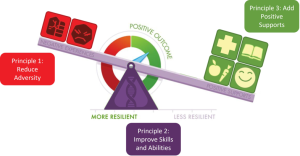
Resilience grows when supports and skills outweigh adversity.
Early educators play a critical role in providing the everyday supports that help children build these skills.
Helping “tip the scale” toward positive development
You may not always be able to change the adversity a child experiences outside the early learning environment. But educators can play a powerful role in tipping the balance toward positive outcomes.
This happens through:
- caring and responsive relationships
- supportive learning environments
- opportunities to build social and emotional skills
- partnerships with families and communities
Each positive interaction contributes to the supports that help children thrive.
Learn more: The Nest and the Resilience Scale
The idea that “what surrounds us shapes us” is captured in two helpful frameworks: The Nest Wellbeing Framework and the Resilience Scale. These frameworks highlight the many layers of environment and relationships that influence children’s development.

Image provided by the author
You can learn more by watching the What Surrounds Us Shapes Us animation, which introduces these ideas in a simple and engaging way.
What Surrounds Us Shapes Us_Resilience Scale and The Nest animation
You can access the free Enabling Workforces Toolkit to explore resources including those linked within this blog for your team.
Queensland Kids Partnership, an initiative or ARACY, is a partnership of people and organisations working to transform systems, so all young Queenslanders can thrive. To do that QKP brings together people, communities, decision-makers, change-makers and workplaces across Queensland to improve connectiveness, learning, and support in communities, workforces and organisations.
To stay informed about the work of Queensland Kids Partnership:
This blog was authored by Queensland Kids Partnership’s Michelle Cole in partnership with Early Years Australia (ECA). It was originally posted on the ECA website as part of Brain Awareness Week 2026.